Buying Your First Plot in Kenya: Every Step from Site Visit to Title Deed
 Eddy NdumiaHead of Technology & Digital Products, Famyard Enterprises
9 min read
Buying land for the first time feels like a lot of unfamiliar words, offices and paperwork. Underneath it, the process follows the same path almost every time. Once you know the steps and what to check at each one, it becomes much easier to stay in control and much harder for anyone to take advantage of you.
This guide walks through the whole journey, from deciding what you want to holding a title deed in your name. It uses plots in Nyeri and Laikipia as the example, since that is where Famyard Enterprises sells, but the steps apply anywhere in Kenya.
The steps at a glance
| Step | What happens | Typical time |
|---|---|---|
| 1. Plan | Set your budget, purpose and area | A few days |
| 2. Shortlist | Compare listings and areas | A week or two |
| 3. Site visit | See the plot, the beacons and the area | One day |
| 4. Due diligence | Official search, check the seller and the survey | One to two weeks |
| 5. Sale agreement | Price, payment plan and timelines in writing | A few days |
| 6. Payment | Deposit and instalments to official accounts | One day to many months |
| 7. Consent and transfer | Land Control Board (for agricultural land), valuation, stamp duty, registration | Several weeks to a few months |
| 8. Title | Title registered in your name and handed over | At the end of transfer |
Step 1: Decide what you want
Before you look at a single listing, answer four questions:
What is your budget? Include more than the plot price. You will also pay for searches, an advocate if you use one, Land Control Board consent where needed, stamp duty and registration. Later you may pay for fencing, water and power connections. Our guide to the extra costs of buying land covers stamp duty in detail.
What is the land for?
- A home to live in soon
- A retirement home
- Rental units
- Farming
- A long-term hold
Each purpose points to a different kind of area. A home needs schools, shops and a hospital within reach. Rentals need tenants, which means jobs or a campus nearby. Farming needs rain and good soil. A long-term hold needs good access and a clean title more than anything else.
Where? Pick a region, then two or three areas in it. If you are new to Nyeri and Laikipia, our 2026 outlook and our list of the best places to buy land near Mount Kenya are good places to start.
How will you pay? Cash, instalments, savings through a SACCO or chama, or a loan. Knowing this early tells you how much plot you can take on. Our guide to financing a plot purchase compares the options.
Step 2: Shortlist plots
Compare listings in your chosen areas on:
- Size. 50x100 ft (an eighth of an acre) is the common size in Nyeri and Laikipia. Check whether a listing says 50x100 or something smaller.
- Title status. Is there a ready title for each plot, or is the land still on a mother title?
- Access. Distance to the nearest tarmac road and town.
- Services. Water and power on site or nearby.
- Who is selling. A company with an office you can visit, or an individual.
Our guide to how to vet a land selling company in Kenya explains what to look for in a seller.
Step 3: Visit the plot
Never buy land you have not seen, either yourself or through someone you trust. On a site visit you should:
- See the beacons for the exact plot and compare them with the survey map.
- Walk the access road from the tarmac and ask what it is like in the rains.
- Look at the neighbours. Are people building? Farming? Is there anything nearby you would not want next to your home?
- Find water and power. Where is the nearest pole and water connection to your plot?
- Visit the nearest town. Check the shops, schools, clinics and transport.
Famyard runs free site visits to all its estates. Our guide to what a Famyard site visit looks like explains how they work and what to bring.
If you cannot travel, for example because you live abroad, send someone you trust and ask for a video call from the plot. Our guide to buying land remotely covers this.
Step 4: Do your due diligence
This is the step that protects your money. Do not skip it, and do not let anyone rush you through it.
Get a copy of the title
Ask the seller for a copy of the title for the exact plot you are buying, not the parent parcel. Note the title number (for example, Nyeri/Municipality Block X/123 or a similar format), the registered owner and the size.
Run an official search
Take the title number to the land registry for the area, or use Ardhisasa if the registry has moved online, and do an official search. The search result shows:
- the registered owner;
- the size of the land;
- any charges (loans secured on the land);
- any cautions, restrictions or caveats.
If the owner on the search is not the person or company selling to you, stop and ask why. If there is a charge or caution, find out what it is and how it will be cleared before you pay. Our title deed verification guide explains the search step by step.
Check the survey
Ask for the survey or mutation map showing your plot. Compare it with the beacons you saw on the ground. If you want extra certainty, hire your own licensed surveyor to confirm the beacons.
Check the seller
- For a company, check that it is registered and has a real office. Visit it.
- For an individual, check their ID against the name on the search.
- Ask other buyers in the same estate about their experience.
Consider an advocate
Many buyers use an advocate to do the search, draft or review the sale agreement and handle the transfer. For a first purchase this is money well spent. Our guide to what an advocate actually does explains the role.
Step 5: Sign the sale agreement
The sale agreement is the contract between you and the seller. It should say:
- the plot number, title number and size;
- the full price;
- the deposit and each instalment, with dates;
- which accounts to pay into;
- who pays which costs (stamp duty is normally paid by the buyer);
- how long the transfer will take after the final payment;
- what happens if either side does not keep its side of the deal.
Read every line. If something you were told on the site visit is not in the agreement, ask for it to be added. Our guide to reading a land sale agreement goes through the clauses.
Before you pay any deposit, go through our list of questions to ask before you pay a deposit.
Step 6: Pay
Some rules that apply to every payment:
- Pay only into the company's official accounts, as written in the sale agreement. Never pay into a personal account or a number someone sends you by SMS or WhatsApp.
- Get a receipt for every payment and keep it safe.
- Confirm account details by calling the office directly on a number you got from their website or their office, not from a message.
Famyard offers flexible payment plans. You can pay in full or in instalments, with the terms written into your agreement.
Step 7: Consent and transfer
Once the plot is fully paid, the transfer begins. For most land in Nyeri and Laikipia it involves these steps:
Land Control Board consent
Agricultural land needs consent from the local Land Control Board before it can be transferred. The seller normally applies, both parties may need to attend, and the board sits on set days, usually monthly. Without consent, the transfer of agricultural land is void. Our guide to Land Control Board consent explains the process.
Valuation and stamp duty
The government valuer assesses the land so stamp duty can be calculated. The buyer pays stamp duty to the Kenya Revenue Authority. The usual rate is 4% of the value for land in municipalities and 2% for land outside them. See our stamp duty guide for how it is worked out.
Registration
The signed transfer, the consent, the stamp duty receipt and the other documents are lodged at the land registry. The registrar registers the transfer, and the land is now in your name.
How long does it take?
It varies with the board's sitting dates, valuation and the registry's workload. A few weeks to a few months is normal. Ask your seller for their usual timeline and get it in writing.
Step 8: Collect your title
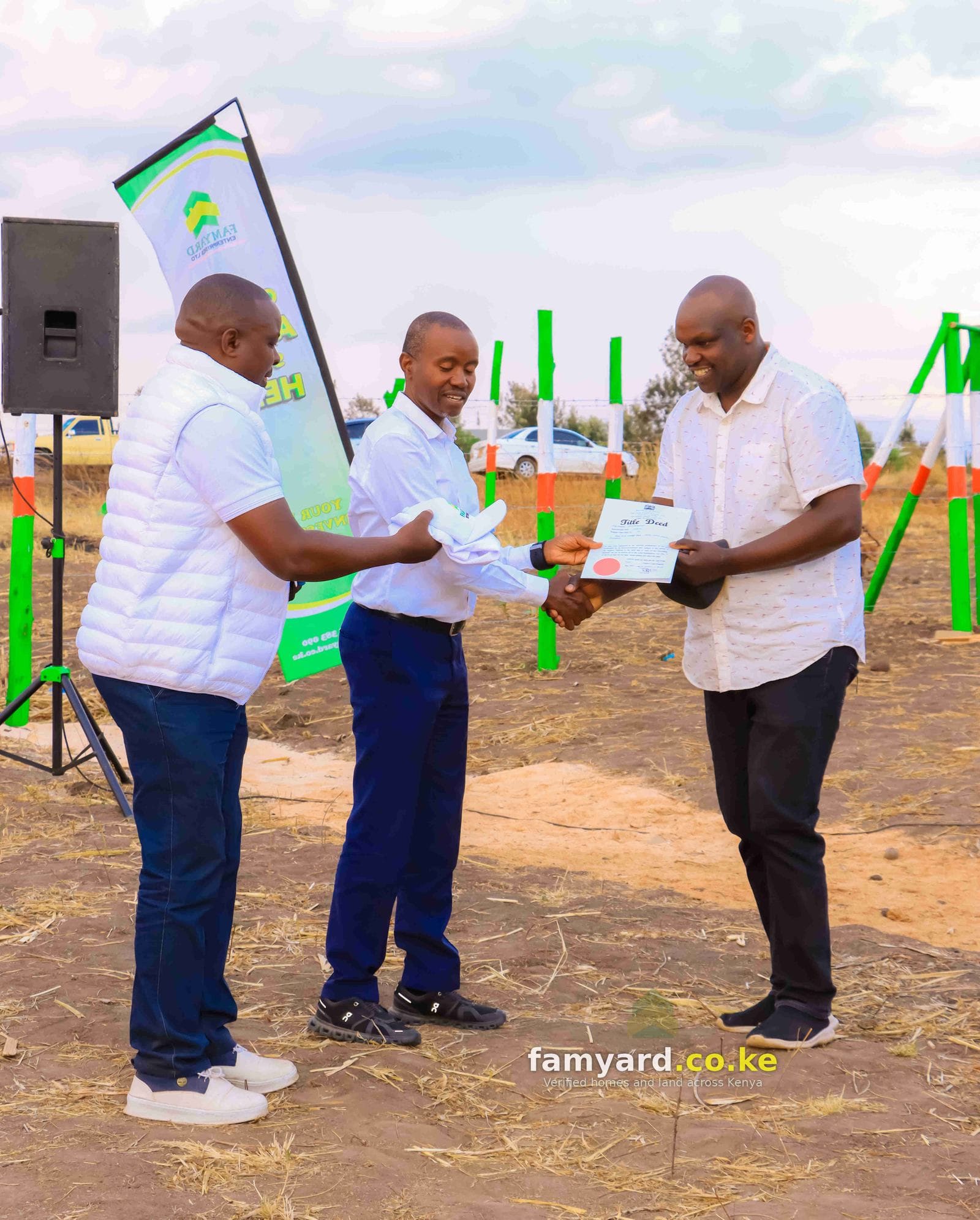
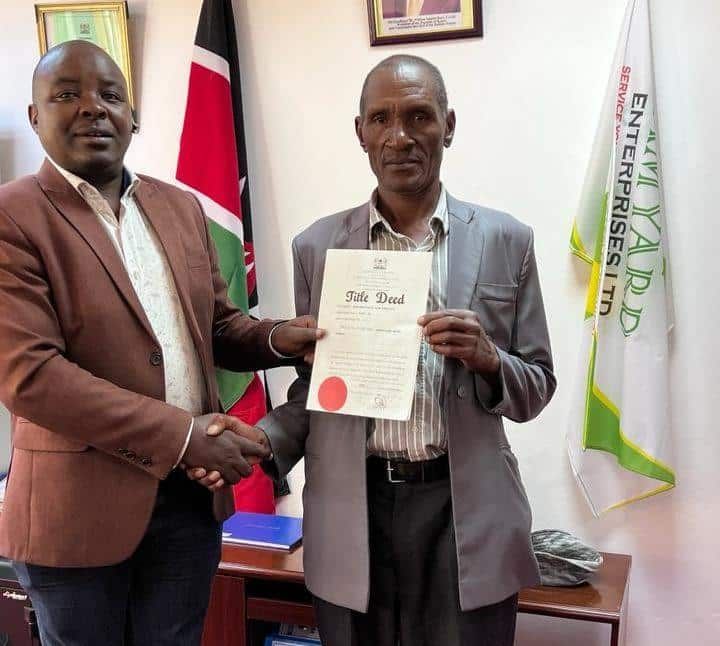
Once registration is done, you get the title deed in your name. Then:
- Do another official search to confirm that the register now shows you as the owner.
- Keep the title somewhere safe, with copies stored separately. Our guide to the documents every land buyer should keep lists what else to file.
- Register for land rates with the county if your plot is in a rated area. Our guide to land rates and land rent explains what you will pay.
What next?
The plot is yours. Common next steps:
- Fence it to keep the boundaries clear, especially if you will not live there soon. See how to fence and secure an undeveloped plot.
- Plan your build. Get approved plans from the county before you start. See our building permits guide and realistic construction budget.
- Put it to work. Farm it, plant trees, or lease it while you save to build. See passive income ideas from land.
Common first-time mistakes
- Paying before searching. Always do the official search first.
- Paying into a personal account. Only pay into accounts in the sale agreement.
- Trusting verbal promises. If it is not in the agreement, it does not count.
- Skipping the site visit. Photos do not show the access road in April.
- Forgetting the extra costs. Budget for stamp duty, consent, searches and fees.
- Not checking the beacons. Make sure the plot you pay for is the plot on the ground.
Our guide to first-time land investor mistakes covers more.
Frequently asked questions
How long does it take to buy a plot and get a title?
If the plot already has its own title and you pay in full, the transfer usually takes a few weeks to a few months, depending on Land Control Board sittings, valuation and the registry. Instalment plans take as long as the payment period plus the transfer.
Do I need an advocate?
It is not required by law, but it is strongly recommended for a first purchase. An advocate does the search, checks the agreement and handles the transfer.
What does a ready title mean?
It means the plot already has its own registered title, separate from the mother title, and can be transferred to you once you finish paying. Our guide to what a ready title deed really means explains how to confirm this.
Can I buy in instalments?
Yes. Famyard offers instalment plans. The amounts and dates are written into the sale agreement.
Can I buy from abroad?
Yes. Many buyers do, using a trusted person on the ground, an advocate and, where needed, a power of attorney. See our guide to power of attorney for diaspora buyers.
Start with a site visit
Browse all Famyard plots, see land for sale in Nyeri County and land for sale in Laikipia County, or call or WhatsApp Famyard Enterprises on +254 119 222666 to book a free site visit.